
Ereele Capital Weekly Newsletter · Edition 8 · 20 September 2026
This Edition at a Snapshot
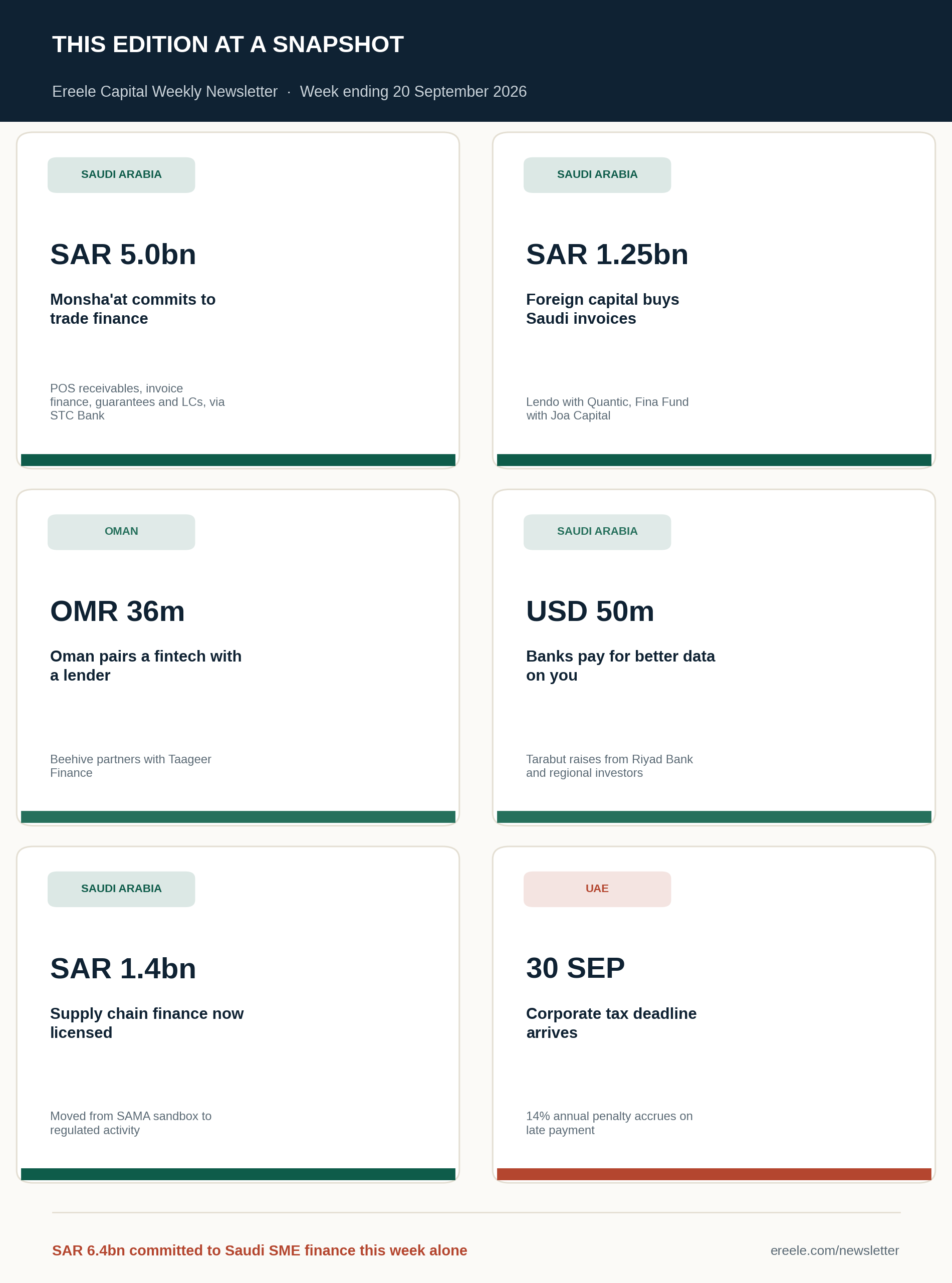
Riyadh spent three days deciding that small business working capital is where the money goes next. Oman produced its own model. And UAE owners have a tax deadline in eleven days.
The 30 second version
| SAR 6.4bn | committed to Saudi SME finance in one week |
| OMR 36m | new funding line for Omani SMEs |
| SAR 1.4bn | supply chain finance, now a licensed activity in Saudi Arabia |
| 11 days | until the UAE corporate tax deadline |
| 11 days | until Bahrain’s Musanada window closes |
If you read nothing else: your large buyer’s invoice is now financeable at your buyer’s credit rating, not yours. Ask their treasury team about supply chain finance this week.
Where the money went
This week’s stories
Tap any story to open it.
1. Saudi Arabia just put SAR 5bn behind trade finance products
Monsha’at and STC Bank signed a SAR 5 billion Shariah compliant portfolio on 17 September, during Money20/20 Middle East in Riyadh. Forget the headline number and read the product list: point of sale receivables, invoice and accounts receivable finance, supply chain finance, guarantees and letters of credit. Terms up to ten years, cash and non cash.
That is transaction finance, not a generic loan pot. It means your card takings and your confirmed orders are now collateral. The market it lands in is already growing: cumulative credit facilities to Saudi MSMEs reached roughly SAR 467 billion by the end of 2025, up 33% year on year.
Do this. Take card payments? Ask about POS receivables financing by name. Supply a large buyer? Ask about supply chain finance. Exporting? Guarantees and letters of credit are inside this facility.
2. Foreign money is buying Saudi invoices
Two more commitments landed in the same week. Lendo, the Shariah compliant debt crowdfunding marketplace, announced a partnership with Quantic Financial Solutions, a Vienna headquartered asset manager, covering an institutional capital programme of up to SAR 750 million for SME working capital.
The day before, Fina, the business to business embedded finance arm of SILQ, launched a SAR 500 million direct financing fund with Joa Capital, licensed by the Capital Market Authority. Fina has already deployed over SAR 2 billion of trade liquidity.
A Viennese fund with no strategic reason to be in Riyadh is now financing Saudi receivables. That is an asset class forming, not a development programme.
Do this. These lenders fund invoices they can verify. A clean purchase order, delivery confirmation and a buyer who will acknowledge the debt beat your balance sheet every time.
3. Oman gets a cleaner version of the same model
Beehive and Taageer Finance are making at least OMR 36 million, roughly USD 93 million, available to Omani SMEs. Beehive brings digital origination and underwriting; Taageer brings the balance sheet, ten branches and local credit experience, with the Oman Investment Authority among its shareholders. Neither could serve this segment alone at acceptable cost.
Peter Tavener, Beehive’s Co Founder and Group Chief Executive, put it simply: more businesses funded, faster. Sheikh Khalil Al Harthy, Taageer’s Chief Executive, framed it against Oman Vision 2040.
Do this. The bar is two years of trading history. That is far lower than the collateral test most Omani banks apply. If you clear it, this route is live now.
4. The banks are paying for better data on you
Tarabut raised USD 50 million from Riyad Bank, GIB Saudi Arabia, the X Tech Fund managed by SAB Invest, Zamil Group and Kanoo Ventures. Note who those backers are: the institutions that already run on the infrastructure. The transaction remains subject to approval from the Saudi Central Bank.
Founder Abdulla Almoayed was blunt about the target. The biggest prize, he said, is SME finance: institutions want to serve more creditworthy businesses, and the infrastructure turns real financial behaviour into a clearer picture for decision making.
Do this. When a lender asks you to connect your bank accounts, that is the fast route, not an intrusion. Live cash flow data beats audited accounts that are eighteen months old.
5. Supply chain finance is now licensed in Saudi Arabia
Quietly disclosed at Money20/20: supply chain finance has moved from the Saudi Central Bank sandbox to licensing, with more than SAR 1.4 billion of activity already through it. Turky A. Kabarah, Director of Fintech Enablement at SAMA, framed the regulator’s posture directly, saying regulatory requirements are a roadmap allowing firms to innovate and scale safely rather than a barrier.
How it works. Your buyer approves your invoice, and a financier pays you early at a discount priced off your buyer’s credit rating. A small supplier to a strong buyer therefore borrows at close to the buyer’s cost of funds, usually far cheaper than any facility that supplier could access alone.
Do this. Insure the receivable first. Insured receivables typically finance at 80% to 90% of invoice value. Uninsured, 60% to 70%. That gap is worth more than any margin you will negotiate.
6. UAE: eleven days, and a cash flow trap
Corporate tax filing and payment is due 30 September for financial years ending 31 December 2025. You must file even with nothing owed. Late filing costs AED 500 a month for the first twelve months and AED 1,000 thereafter, while unpaid tax accrues a penalty at 14% a year from the day after the due date.
The trap nobody mentions: that payment lands in the same week as payroll, which UAE employers must now run by the first of the month under Ministerial Resolution No. 340 of 2026. Separately, Small Business Relief has been extended to cover qualifying periods ending on or before 31 December 2029 for businesses under AED 3 million of revenue.
Do this. If the payment is the problem rather than the filing, call your bank now. A working capital line costs far less than 14%.
Our view, in four lines
SAR 6.4 billion sounds enormous. The Saudi gap is SAR 400 billion. A week this good covers 1.6% of one country’s problem.
What changed is the plumbing, not the volume. Every deal this week routed capital to small borrowers through someone who already sees their transaction data. Not one was a bank widening its credit box.
So stop starting with your bank. Ask your payment processor, your marketplace, your accounting software. The application you can complete with data they already hold will beat the one needing three years of audited accounts.
Then do the boring part. Clean purchase orders. Buyer acknowledgement. Consistent banking records. Insurance on the receivable. That is the difference between a 60% advance and a 90% one.
Diary
| When | What | Where |
|---|---|---|
| 24 Sep | What’s Up Digital Lending | Paris |
| 30 Sep | UAE corporate tax deadline | UAE |
| 30 Sep | Tamkeen Musanada closes | Bahrain |
| 7 Oct | ITFA webinar, FI trade in Africa | Online |
| 8 Oct | Global Trade Finance Expo | Dubai |
| 30 Oct | UAE electronic invoicing deadline, AED 50m and above | UAE |
| 3 to 4 Nov | MENA Supply Chain Finance | Dubai |
| 25 Nov | Qatar Investors Forum | Doha |
More editions of the Ereele Capital Weekly Newsletter
Subscribe to the newsletter
Get the Ereele Capital Weekly Newsletter in your inbox. GCC SME funding and trade finance, every week.


Ereele Capital. Bridging capital and opportunity across the GCC.
Researched from primary sources including the Saudi Press Agency, Arab News, Money20/20 Middle East announcement releases, PR Newswire, company statements and regulator publications. Figures are as announced by the parties involved. This is general information and not financial advice. Eligibility, pricing and terms must be confirmed directly with each provider.
 Ereele Capital