
Ereele Capital Weekly Newsletter · Edition 9 · 27 September 2026
Four regulators moved in the same direction this week: financing has to reach the supplier and the small business faster. PIF built a platform for it, Oman built a portal, Kuwait built a law, and the GCC’s biggest fintech round of the year went straight into SME payments.
The 30 second version
| Saudi Arabia | PIF launches Tawrid, a supply chain finance platform, with 5 binding bank and developer partners |
| USD 35m | Paymob’s pre Series C round, led by Mubadala and EBRD, to scale GCC SME payments |
| UAE | Sukoon and CMECIC form a trade credit insurance partnership for SME receivables |
| Oman | Central Bank unveils a National Fintech Strategy and Fintech Portal for SME market entry |
| Law No. 90 | Kuwait’s new sukuk law widens sovereign and corporate funding routes |
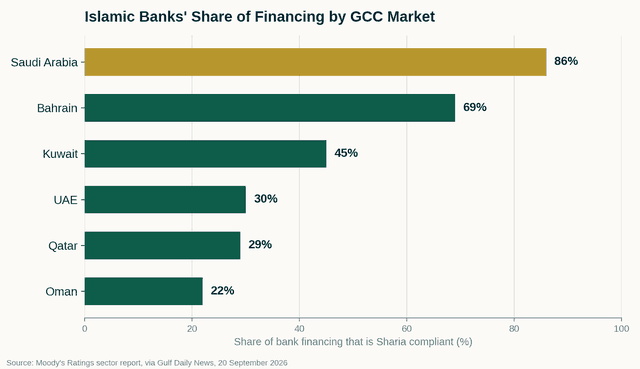
| 86% | Share of Saudi bank financing that is now Islamic, the highest in the GCC, per Moody’s |
If you read nothing else: four different GCC regulators are now competing on how fast financing reaches a small business, not just how much of it exists.
Islamic banks now dominate GCC financing
This week’s stories
Tap any story to open it.
1. Saudi Arabia: PIF launches Tawrid to unlock SME working capital
PIF has launched Tawrid, a digital supply chain finance platform connecting buyers, suppliers and financial institutions, allowing suppliers to receive early settlement against approved invoices. The platform commenced operations on 20 September 2026, after entering the Saudi Central Bank’s regulatory sandbox in September 2025.
Tawrid has signed binding agreements with Gulf International Bank, Saudi National Bank, Banque Saudi Fransi, ROSHN Group and Nesma and Partners. Sultan Alsheikh, Head of Financial Institutions in MENA Investments at PIF, said the platform will make Saudi supply chains stronger and more resilient by enabling companies to access financing and improve liquidity management.
Do this. Saudi based suppliers working with the named developers and banks should register early. Invoice backed financing at this scale directly narrows the working capital gap that keeps smaller vendors out of large procurement chains.
2. UAE and Region: Paymob raises USD 35 million to scale GCC SME payments
Egypt founded fintech Paymob raised USD 35 million in a pre Series C round co led by Mubadala Investment Company and the European Bank for Reconstruction and Development, with participation from British International Investment, Global Ventures and DPI Ventures. The round closed on 21 September 2026.
Since securing its UAE Retail Payment Services Licence in January 2025, Paymob has onboarded roughly 20,000 merchants across three GCC markets, with GCC revenue growing sevenfold and now close to half of total revenue. Islam Shawky, Co Founder and CEO, said Paymob has become a regional platform propelled by the growth of its GCC business. Bruno Lusic, VC and Growth Investor at EBRD, said Paymob has built the payments infrastructure that MENA’s SME economy has been missing.
Do this. GCC SME merchants juggling multiple payment providers should evaluate Paymob’s expanding acceptance network as a single rail, particularly ahead of the agentic commerce tools this funding is earmarked to build.
3. UAE: Sukoon and CMECIC form a trade credit insurance partnership
Sukoon Insurance and CMECIC announced a strategic partnership on 22 September 2026 to expand trade credit insurance solutions in the UAE, combining CMECIC’s underwriting expertise with Sukoon’s S&P Global A rating, Moody’s A2 IFSR and a panel of globally recognised reinsurers.
The partnership is designed to help businesses protect receivables and secure financing while managing counterparty risk. Hammad Khan, Interim CEO of Sukoon, said the priority is to empower businesses with the tools they need to navigate an evolving economic environment. David Avasthi, Managing Director and Chief Underwriting Officer at CMECIC, said the firms are pleased to collaborate in delivering specialised credit insurance solutions.
Do this. SMEs extending open account terms to regional buyers should ask their broker whether this panel now covers their receivables. Credit insured receivables are increasingly what banks want to see before extending working capital lines.
4. Oman: Central Bank unveils a National Fintech Strategy and Portal
Oman launched an integrated National Fintech Strategy and Oman Fintech Portal on 22 September 2026, aimed at building a future ready financial ecosystem aligned with Oman Vision 2040. Ahmed Al Musalmi, Governor of the Central Bank of Oman, is overseeing implementation alongside the Financial Services Authority and Ministry of Finance.
The Fintech Portal gives applicants a clearer, more coordinated pathway into the market, connecting them with ecosystem partners and regulators. The strategy specifically cites expanding opportunities for entrepreneurs and small enterprises through accessible, needs driven financial solutions.
Do this. Fintechs and SME lenders eyeing Oman should use the new portal as the first stop rather than approaching regulators piecemeal. A coordinated entry pathway usually means faster licensing timelines for early movers.
5. Kuwait: new sukuk law widens government and corporate funding routes
Kuwait’s Finance Ministry confirmed on 20 September 2026 that Law No. 90 of 2026 now permits sukuk alongside conventional debt instruments in the country’s sovereign financing structure. Dr Yaqoub Al Refaei, Finance Minister, called it an important step in developing Kuwait’s sovereign financing framework. Faisal Al Muzaini, Director of the Public Debt Department at the Kuwait Ministry of Finance, said the law provides greater flexibility in managing the debt portfolio by diversifying instruments, markets, maturities and investors.
A sovereign sukuk issuance would establish Kuwait’s first domestic yield curve benchmark, which typically lowers the cost of later corporate and bank issuance and deepens secondary market liquidity.
Do this. Kuwaiti corporates planning a debut sukuk should watch the sovereign’s first issuance closely. Pricing off a new domestic benchmark, rather than an international curve, could materially change their cost of funds.
6. Region: Islamic banks dominate GCC financing, Moody’s finds
Moody’s Ratings reported this week that Islamic banks account for 86% of bank financing in Saudi Arabia, a market exceeding USD 700 billion, the highest share in the GCC. Bahrain follows at 69%, Kuwait at 45%, the UAE at 30%, Qatar at 29% and Oman at 22%.
Separately, Moody’s also reported that GCC sukuk issuance fell 23% year on year to USD 51.1 billion in the first half of 2026, citing regional disruption and sovereign funding timing, but expects a gradual second half recovery toward full year issuance of roughly USD 280 billion, in line with 2025.
Do this. Trade finance providers structuring facilities for Saudi and Bahraini counterparties should default to Sharia compliant structures as the base case, not the alternative.
Our view, in four lines
Six stories, four regulators, one direction. Financing has to reach the supplier and the small business faster than it used to, and every GCC state named this week built its own route to get there.
That is competition, not coincidence. PIF built a platform. Oman built a portal. Kuwait built a law. Each is a state deciding to become the easiest place in the region to fund a small business.
The money followed the same logic. Paymob’s largest ever round went straight into GCC SME payment rails, not into the Egyptian business that built the company.
So position the receivable, not just the relationship. Insured, invoice backed and platform verified receivables are what is moving this quarter. A strong banking relationship alone increasingly is not.
Diary
| When | What | Where |
|---|---|---|
| 8 Oct | Global Trade Finance Expo | Dubai |
| 2 to 3 Nov | Dubai FinTech Summit | Dubai |
| 7 to 10 Dec | Abu Dhabi Finance Week | Abu Dhabi |
More editions of the Ereele Capital Weekly Newsletter
Subscribe to the newsletter
Get the Ereele Capital Weekly Newsletter in your inbox. GCC SME funding and trade finance, every week.


Ereele Capital. Bridging capital and opportunity across the GCC.
Researched from primary sources including PIF, Arab News, the Kuwait Times, Oman Observer, Times of Oman, Zawya, Wamda, Gulf Daily News and Moody’s Ratings publications. Figures are as announced by the parties involved. This is general information and not financial advice. Eligibility, pricing and terms must be confirmed directly with each provider.

